Archive Scanning Services UK - Secure Digitisation of Historical & Legacy Records
Professional archive scanning for historical, inactive, and legacy records – handled with the care they deserve.
Archive Scanning Services for UK Organisations
Physical archives deteriorate. Paper yellows and becomes brittle, ink fades, microfilm degrades, and storage conditions – however carefully managed – work against preservation over time. The longer digitisation is deferred, the greater the risk of permanent loss.
Pearl Scan’s archive scanning service is designed specifically for historical, legacy, and inactive records – the documents your organisation needs to retain but rarely accesses, the collections that contain irreplaceable information, and the archives that standard scanning workflows are not equipped to handle.
We digitise everything from century-old paper records and fragile bound volumes to microfilm reels, photographic negatives, and deteriorating documents – producing archival-quality digital files that preserve the integrity of your records for decades to come.
Part of our wider document scanning services – specialist handling for your most important historical records.
Why Archive Digitisation Cannot Wait
Physical Media Deteriorates - Irreversibly
Paper records degrade through humidity, light exposure, and handling. Microfilm and microfiche have a finite shelf life – typically 50 – 100 years under ideal conditions, far less in practice (what is microfiche. Once records are lost to deterioration, they cannot be recovered. Digitisation creates a permanent, stable copy before that window closes. Read our blog about document archiving the top three methods.
Ageing Playback Equipment Will Fail
Many UK organisations hold archives on microfilm, microfiche, and aperture cards that can only be read with specialist equipment. That equipment is ageing, increasingly difficult to service, and no longer manufactured. Conversion to digital format before the hardware fails entirely is not optional – it is a matter of organisational continuity.
Inactive Records Are Not Worthless Records
Archives contain historical contracts, compliance evidence, financial records, and correspondence that may be legally required years after the fact. Inactive does not mean unimportant – and when a disclosure request, audit, or litigation arises, inaccessible paper records become a serious liability.
Storage Cost Is an Ongoing Overhead
Off-site storage facilities charge monthly fees for physical archive boxes indefinitely. Digitising and applying your retention policy to the resulting digital archive typically eliminates or substantially reduces that overhead – often recovering the cost of digitisation within two years.
Staff Knowledge Walks Out the Door
The people who know where your archive is organised, what the filing conventions mean, and which box contains which records will not be with your organisation forever. When that institutional knowledge leaves, paper archives become harder to navigate. An indexed digital archive removes that dependency entirely.
Compliance Deadlines Have Consequences
GDPR and sector-specific retention policies require organisations to be able to produce, and to demonstrate disposal of, records on demand. Indexed digital archives make compliance straightforward. Paper archives make it a manual, time-consuming exercise that carries real risk of non-compliance.
Archive Formats We Digitise
Our archive scanning service handles every format commonly found in UK document archives – including specialist and legacy media that general scanning bureaux cannot accommodate.

Bound Volumes, Ledgers & Books
Bound materials – ledgers, registers, minute books, technical manuals, and publications – are scanned using V-cradle book scanners that eliminate spine stress and capture content without risk to the binding. We produce high-resolution, properly paginated digital files suitable for both reference and preservation. See our specialist book scanning service for dedicated publishing and heritage projects.

Historical Paper Documents & Legacy Records
Aged, yellowed, or brittle paper records require careful preparation before scanning. Our operatives are trained in fragile document handling – documents are never forced flat, tears are repaired before capture, and fragile pages are individually handled throughout. Output is produced at the resolution appropriate for the document’s age, print quality, and intended use.

Large Format Archive Documents
Historical maps, architectural drawings, engineering plans, and survey documents up to A0 size are captured on our large format scanners at resolutions appropriate for technical detail and reproduction. Output as high-resolution TIFF or searchable PDF. See our large format scanning service for dedicated technical drawing projects.

Microfilm & Microfiche Conversion
We convert 16mm and 35mm microfilm reels, all standard microfiche formats, aperture cards, and jacketed film into searchable digital files – eliminating your dependency on ageing playback hardware before it fails. Output as searchable PDF, TIFF, or JPEG with full index files. See our dedicated microfiche and microfilm scanning service.

Photographic Archives & Film Negatives
Historical photograph collections, glass plates, film negatives, and slides are digitised at archival resolutions with appropriate colour management – producing digital masters suitable for preservation, reproduction, and publication. See our dedicated photo scanning service for photographic archive projects.

Heritage & Cultural Collections
Manuscripts, maps, periodicals, magazines, newspapers, and culturally significant collections require specialist handling and archival-standard digitisation. Our heritage scanning service produces BS10008 – compliant outputs suitable for long-term preservation and public access programmes. See our heritage scanning service.
Our Archive Scanning Process

1. Secure Collection & Chain of Custody
Your archive is collected by our DBS-checked operatives using GPS-tracked vehicles and sealed transfer containers. A full documented chain of custody is maintained from your premises to our bureau – every box, every item, fully accounted for throughout.

2. Specialist Preparation
Archive preparation is more involved than standard document scanning. Staples and bindings are removed where safe to do so. Tears and fragile sections are carefully repaired. Deteriorating documents are handled individually. Microfilm reels are cleaned before scanning. No document is scanned before it is ready – quality starts at preparation, not at the scanner.

3. Scanning, OCR & Indexing
Documents are scanned at the resolution appropriate for their age, format, and intended use. OCR processing converts scanned images into text-searchable digital files. Indexing is applied to your specification – document type, date, reference number, or any custom metadata fields required for integration with your document management system or database.

4. Quality Assurance & Delivery
Every output is checked for image clarity and completeness before delivery – in accordance with our ISO 9001 and BS10008 standards. Files are delivered via secure download, USB, or direct upload to Pearl Cloud, SharePoint, or your existing system. Originals are shredded , returned, or placed into managed storage. See our full scanning process.
Not sure how many pages you need to scan?
Try our page count calculator!
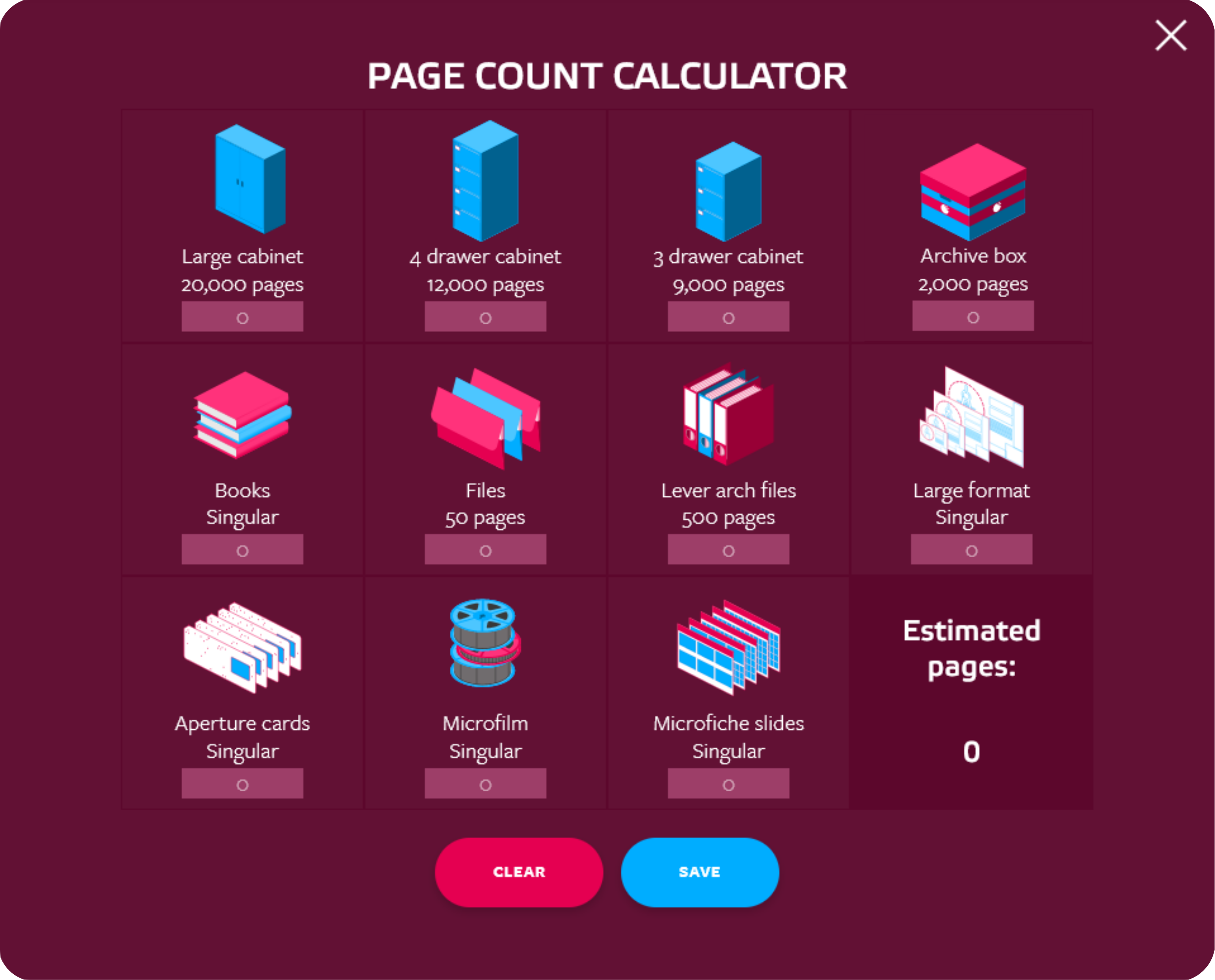
PAGE COUNT CALCULATOR
Archive Scanning Output – Formats & Resolutions
File Formats
- Searchable PDF – standard output, OCR-processed
- PDF/A – ISO archival standard for long-term preservation
- TIFF – maximum resolution, lossless, preferred for heritage collections
- JPEG – photographs and colour image archives
- Multi-page PDF with embedded OCR text layer
- Word / Excel via advanced OCR for data extraction
- Structured CSV/XML index files for database integration
Scanning Resolutions
- Standard A4/A3 documents – 300 DPI (optimal for OCR)
- Small print / aged documents – 300 – 400 DPI
- Photographic materials – 400 – 600 DPI
- Large format technical drawings – 300 – 400 DPI minimum
- Heritage / archival masters – up to 600 DPI
- Microfilm / microfiche – format-specific resolution
- Resolution confirmed during consultation and pilot scan
















Flexible Archive Scanning Options
Project-Based Archive Digitisation: The right approach for one-time archive clearances – office relocations, compliance programmes, storage facility closures, or historical collection digitisation. We manage the entire process from assessment to delivery. Most projects complete within 2–6 weeks depending on volume and complexity.
Ongoing Archive Management: For organisations that regularly transfer active records to inactive storage, we provide a scheduled collection and digitisation service – ensuring your digital archive stays current without manual intervention. Collections can be weekly, monthly, or quarterly.
On-Site Archive Scanning: When documents cannot leave your premises – due to regulatory requirements, contractual obligations, or the fragility of the materials – our team brings the equipment to you. Same archival-quality output, same security standards, no off-site transportation. Learn more about on-site scanning.
Long-Term Archive Management with Pearl Cloud
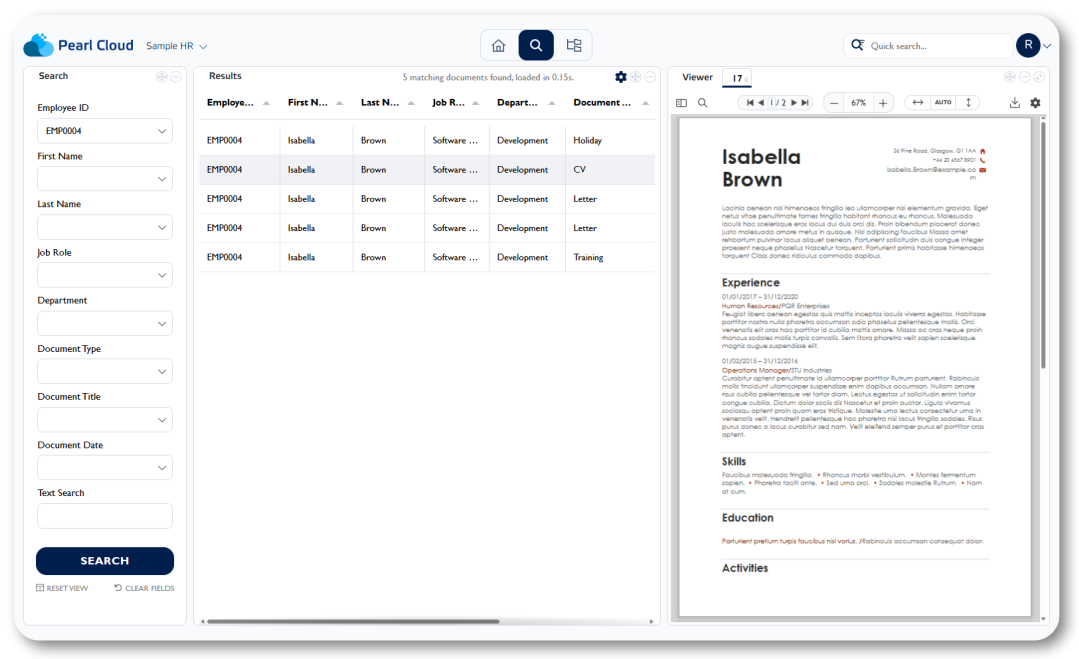
A digitised archive is only as useful as your ability to search and retrieve from it. Pearl Cloud is Pearl Scan’s secure cloud document management platform – purpose-built for organisations managing large collections of scanned historical and legacy records.
- Instant search: Find any document across millions of pages using full OCR text search or metadata – in under one second.
- Preservation-grade security: ISO 27001 certified, 2FA, role-based access, full audit trails, and encrypted storage.
- No IT overhead: Fully managed platform – no server infrastructure, no backup management, no maintenance.
- Retention management: Apply and automate your retention policy directly within the platform – flag, review, and dispose of records on schedule.
- Accessible anywhere: Authorised users can retrieve records from any device, any location – the same document your legal team needs is available to your compliance officer simultaneously.
Prefer your existing system? We deliver directly into SharePoint or any third-party DMS. Learn more about Pearl Cloud.
Why Choose Pearl Scan for Archive Scanning?

Specialist Handling for Aged Materials
Not all scanning bureaux are equipped – or willing – to handle genuinely fragile, aged, or damaged documents. Our operatives are trained specifically in archive preparation and fragile material handling. We do not turn away difficult collections.

Archival-Quality Output Standards
We produce outputs to BS10008 standard for legal admissibility and archival-grade TIFF and PDF/A files for long-term preservation. Resolution, colour management, and file format are all determined by the specific requirements of your collection – not a one-size-fits-all default.

23 Years Digitising UK Archives
We have digitised heritage collections for Jodrell Bank Observatory, historical records for Lord’s Cricket Ground, university archives, NHS patient records, and government document collections. Our case studies reflect the breadth and complexity of archive projects we have successfully delivered.

ISO 9001 & BS10008 Quality Assurance
Every archive scanning project is delivered under our ISO 9001:2015 quality management system. Multi-point inspection on every batch. Any image that fails our clarity or completeness standards is rescanned before delivery. BS10008 compliance is maintained throughout for legal admissibility.
Dedicated Project Management
Every archive project has a named Project Manager – your single point of contact from assessment to final delivery. For complex, multi-format collections, this matters. You are not passed between teams or left waiting for updates.
See our archive project case studies: Jodrell Bank Observatory | Lord’s Cricket Ground | University of Salford | View all case studies