Managing employee records efficiently whilst maintaining compliance with UK data protection regulations has become a critical challenge for organisations across all sectors. Traditional paper-based HR filing systems are not only space-consuming and costly, but they also pose significant security risks and compliance challenges in an era of stringent
GDPR requirements. According to recent research, 68% of UK businesses are leading Europe in stepping up digital HR offerings, recognising that digital transformation is no longer optional but essential for competitive advantage and operational efficiency.
This comprehensive guide explores the modern methods of HR document management, from innovative scan-on-demand approaches to fully integrated cloud-based systems, helping you navigate the transition from paper to digital whilst ensuring complete GDPR compliance.
The Challenge of Traditional HR Document Storage
For decades, organisations have struggled with managing vast quantities of employee files in traditional paper formats. A typical employee file contains numerous critical documents including pre-employment paperwork, background screening results, identity verifications, employee relations records, TUPE documentation, and for international organisations, essential immigration documents.
The problem intensifies after an employee’s departure. According to UK statutory retention requirements, organisations typically store ex-employee files for six to ten years after their leave date, with certain sectors such as investment banking, government agencies, and the defence sector requiring even longer retention periods. This translates to thousands of boxes occupying valuable office space or incurring substantial offsite storage costs.
The CIPD highlights that retrieval times for paper-based systems can take hours or even days, particularly when documents are stored offsite. Walking down corridors to basement archives or travelling to external storage facilities simply doesn’t align with the fast-paced demands of modern business operations.
Furthermore, paper documents present serious security vulnerabilities. Physical files can be misfiled, damaged, or accessed by unauthorised personnel, creating compliance risks that can result in substantial fines under UK GDPR regulations.
Modern HR Document Management Approaches
The digital transformation of HR document management offers organisations two primary methodologies for structuring their electronic files, each with distinct advantages depending on organisational requirements and budget constraints.
File-Level Indexing Versus Document-Level Indexing
File-Level Indexing:
Involves scanning and digitising all documents contained within a specific employee’s folder, consolidating them into a single comprehensive PDF file. This approach simplifies document management by creating an electronic version of the entire physical folder, making it straightforward to store, search, and access the complete collection as one unit. It’s ideal for organisations requiring quick access to entire employee records without the need for granular document separation.
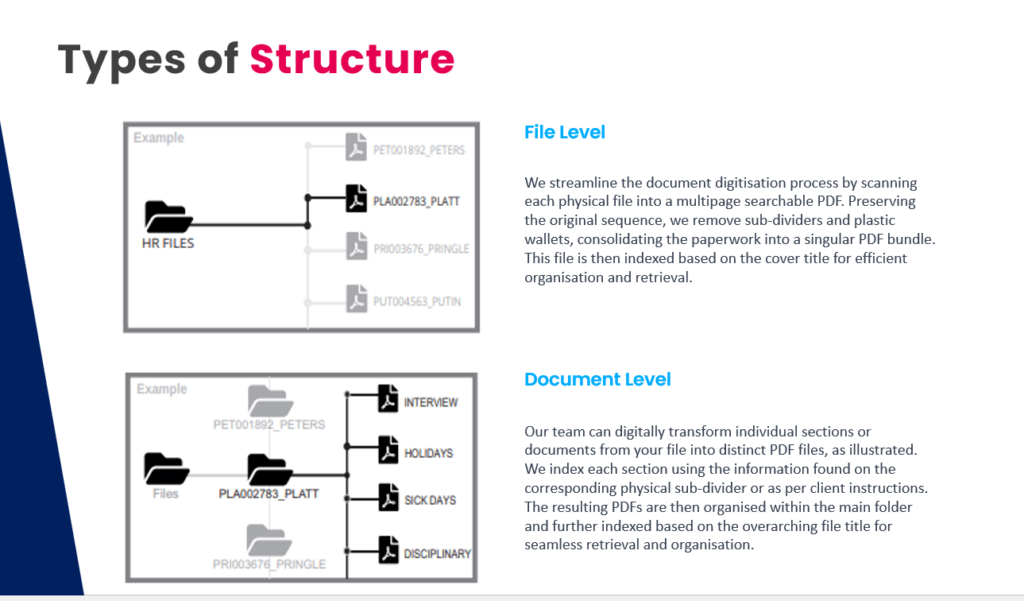
Document-Level Indexing:
Takes a more sophisticated approach by scanning individual documents within each employee folder separately. Each document – whether it’s an application form, employment contract, performance appraisal, training certificate, or disciplinary record – is scanned and saved as its own individual PDF file with specific metadata tagging.
With document-level indexing, each file is typically indexed using three primary fields:
- Employee name or unique identifier
- Document type (contract, appraisal, training record, etc.)
- Document date or relevant time period
This granular approach provides exceptional flexibility in document management, allowing HR professionals to locate specific documents without needing to review entire employee files. It significantly reduces retrieval time and enhances the user experience when searching for particular records.
The Scan-On-Demand Hybrid Approach
For organisations facing budgetary constraints or seeking to phase their digital transformation, the scan-on-demand model offers an intelligent hybrid solution that balances immediate digitisation needs with cost-effectiveness.
This approach involves fully digitising current employee files with comprehensive GDPR cleansing, ensuring that active records are immediately accessible through your document management system. Meanwhile, ex-employee files are stored securely using a ‘store and scan on demand’ methodology, where documents remain in physical format but are scanned only when specifically requested.
The benefits of this hybrid approach include:
- Immediate digital access to all current employee records
- Significant cost savings by digitising historical files only when needed
- Reduced initial project scope and faster implementation
- Maintained compliance with retention requirements for ex-employee data
- Flexibility to fully digitise archived files over time as budget allows
This methodology particularly suits organisations undergoing rapid growth or those managing legacy archives whilst simultaneously implementing modern HR systems for new employees.
Pearl Cloud HR System: The Complete Solution
For organisations seeking a comprehensive, turnkey solution, Pearl Cloud represents a modern HR document management system. This out-of-the-box, user-focused, and fully managed solution can be implemented by SMEs and large corporations alike, with support for multiple locations and individual country-specific compliance rules.
What distinguishes Pearl Cloud is its emphasis on simplicity and total cost of ownership. The system has been refined through almost two decades of experience in employee file handling, document scanning, creating detailed inventories, and categorising documentation across various industries. This extensive experience enables Pearl Scan to be significantly more versatile and knowledgeable than standard box-scanning service providers.
Every Pearl Cloud implementation begins with a complimentary onsite survey of your existing methodologies and preferred approaches. This consultative process includes a proof of concept for the ideal solution tailored to your organisation’s unique requirements – at zero cost and with no obligation to proceed.
GDPR Compliance and Data Retention Requirements
UK organisations must navigate complex data protection regulations when managing employee records. The Information Commissioner’s Office (ICO) stipulates that personal data should not be kept longer than necessary for the purpose it was collected, yet various statutory requirements mandate specific retention periods.
Key retention periods for HR documents include:
- Payroll and tax records: Six years from the end of the tax year (HMRC requirement)
- Right to work documentation: Two years after employment ends
- Disciplinary and grievance records: Six years after employment concludes
- Working time records: Two years from the date to which they refer
- Accident records: Three years from the incident date (RIDDOR 2013)
Professional HR document scanning services ensure that your digital repository includes automated retention schedules, preventing organisations from inadvertently holding data longer than legally permitted whilst also ensuring documents aren’t prematurely destroyed before the minimum retention period expires.
Pearl Scan’s services are conducted by extensively vetted staff who undergo stringent background checks for information security and maintain strict confidentiality through signed secrecy agreements, ensuring complete compliance with GDPR Article 32 requirements for appropriate security measures.
Benefits of Digital HR Document Management
The transition to digital HR document management delivers transformative benefits that extend far beyond simple space savings.
Research indicates that organisations implementing digital HR transformation experience measurable advantages including increased retention, enhanced decision-making capabilities, and significant cost reductions.
Enhanced Efficiency and Productivity
Digital files can be retrieved in seconds rather than hours or days. HR professionals can instantly access employee records from any location with appropriate security credentials, enabling remote working and faster response times to employee enquiries. Studies show that automation of repetitive administrative tasks can save substantial time, allowing HR teams to focus on strategic initiatives that add genuine value to the organisation.
Superior Security and Access Control
Digital document management systems provide granular access controls, ensuring only authorised personnel can view sensitive employee information. Comprehensive audit trails track every access instance, modification, and download, providing complete visibility for compliance audits. Advanced encryption protects data both in transit and at rest, significantly reducing the risk of data breaches compared to physical file storage.
Cost Reduction
Organisations eliminate ongoing costs associated with physical storage, including offsite storage fees, filing cabinet maintenance, and the substantial office space previously allocated to archives. Additionally, the reduction in manual filing and retrieval labour represents significant operational savings that compound annually.
Business Continuity and Disaster Recovery
Digital documents stored in secure cloud environments with automated backup procedures ensure business continuity even in the face of physical disasters such as floods, fires, or other emergencies. Unlike paper documents, which can be irretrievably lost, digital files can be recovered and accessed from multiple locations.
Improved Employee Experience
Modern digital systems can provide employee self-service portals where staff can securely access their own records, update personal information, and submit documentation electronically. This empowerment reduces administrative burden on HR teams whilst enhancing employee satisfaction through increased transparency and accessibility.
Integration Capabilities with Existing HR Systems
A critical consideration when implementing HR document management solutions is seamless integration with your existing technology ecosystem. Pearl Scan’s systems are specifically designed to work harmoniously with leading HR platforms, avoiding the creation of information silos that plague many organisations.
The integration capabilities extend to popular systems including Microsoft SharePoint, Octopus, Cascade, and CIPHR, ensuring that document access is unified within your team’s familiar working environment. This eliminates the need for staff to learn multiple systems or repeatedly log into separate platforms, streamlining workflows and reducing user resistance to adoption.
Furthermore, Pearl Scan’s experienced in-house IT department collaborates directly with clients to customise data import structures, field mappings, and search functionalities to align with your organisation’s specific requirements and existing procedures. This bespoke approach ensures that the transition from paper to digital enhances rather than disrupts your established workflows.
For organisations utilising OCR (Optical Character Recognition) technology, documents become fully searchable, allowing users to locate specific information within documents using keyword searches rather than relying solely on manual indexing. This capability significantly enhances information retrieval efficiency across large document repositories.
To Summarise:
The transformation from paper-based to digital HR document management represents more than a simple technology upgrade – it’s a fundamental reimagining of how organisations handle their most valuable asset, their people’s information. As UK businesses continue to lead Europe in digital HR investment, the competitive advantage of modern document management systems becomes increasingly apparent.
Whether you choose the comprehensive approach of document-level indexing, the budget-conscious scan-on-demand methodology, or the fully managed Pearl Cloud solution, the benefits of digital transformation are substantial and measurable. Reduced costs, enhanced security, improved compliance, and superior accessibility all contribute to a stronger, more efficient HR function.
With almost two decades of specialist experience in HR document management, Pearl Scan offers organisations a proven pathway to digital transformation. Our complimentary consultations, proof-of-concept demonstrations, and flexible implementation options ensure that your transition to modern HR document management aligns perfectly with your organisational needs and budget constraints.
The question facing organisations today is not whether to digitise HR documents, but rather how quickly can you implement these modern methods to gain competitive advantage. As GDPR requirements continue to evolve and employee expectations for service excellence rise, the time to modernise your HR document management is now.
For more information about transforming your HR document management and to schedule your complimentary consultation, visit www.pearl-scan.co.uk or explore our comprehensive range of
scanning services to discover how we can support your organisation’s digital transformation journey.